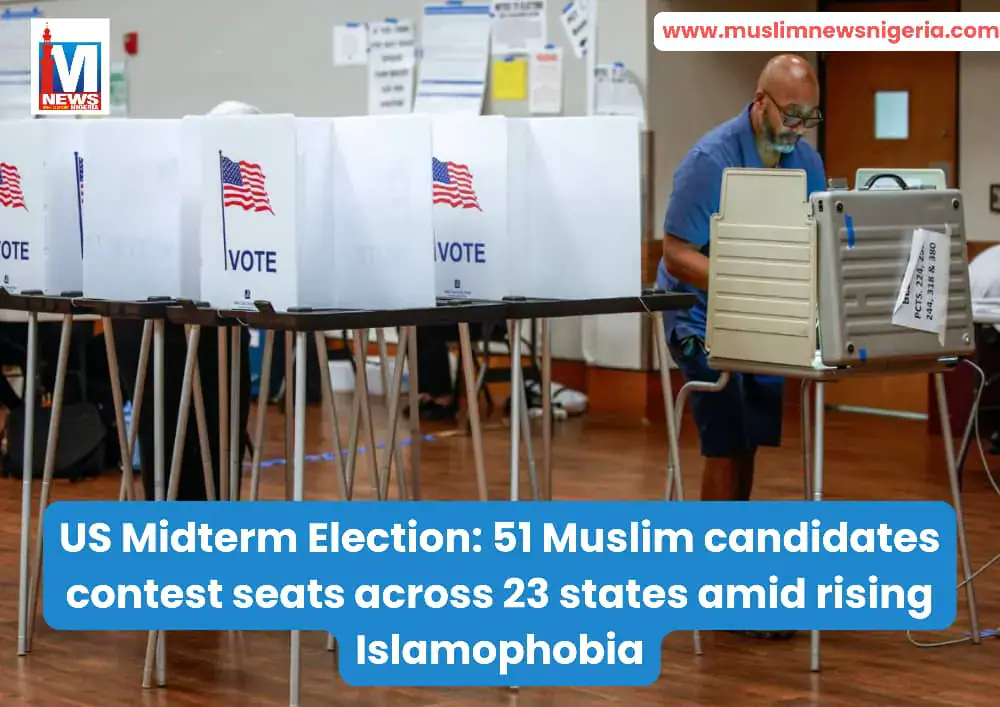
The United States midterm elections, scheduled for November 3, 2026, will see at least 51 Muslim Americans contesting seats across approximately 23 states. These candidates are seeking positions in the US Senate, House of Representatives, state legislatures, county administrations, and other local offices. This significant showing of Muslim participation in the country's electoral politics comes as debates over the economy, civil rights, and US foreign policy dominate campaigns.
According to an analysis by Muslim Network TV (MNTV), 11 of the 51 candidates are contesting federal legislative positions, comprising one Senate candidate and 10 candidates for the House of Representatives. The most closely watched race is in Michigan, where Democratic candidate Abdul El-Sayed is challenging Republican Mike Rogers for a seat in the US Senate. El-Sayed, a physician and former Detroit health director, could become the first Muslim elected to the US Senate if he wins the contest.
Other Muslim candidates seeking seats in the House of Representatives include incumbent lawmakers Ilhan Omar of Minnesota, Rashida Tlaib of Michigan, and André Carson of Indiana. The list also includes Lateefah Simon and Aisha Wahab of California, Adam Hamawy of New Jersey, Darializa Avila Chevalier of New York, Republican candidate Zuhdi Jasser of Arizona, and independent candidates Ahsen Mujeeb Malik and Alaha Ahrar of Virginia.
The MNTV analysis showed that most of the identified candidates are running under the Democratic Party. Of the 51 candidates, 40 are Democrats, four are Republicans, four are contesting nonpartisan races, two are independents, and one is running under the Green Party. Beyond Congress, 34 candidates are seeking seats in state legislatures, while others are contesting county, local, and judicial positions.
The campaigns are taking place amid intense national debates over the wars in Gaza and Iran, immigration, civil rights, religious discrimination, and the cost of living. US policy towards Israel and the conflict in Gaza has become a significant issue for some Muslim and Arab American voters, with activists calling for changes to Washington's military and diplomatic support for Israel. However, domestic economic concerns also feature prominently in the election discussions.
A survey of 413 likely Muslim and Arab American voters in Michigan found that 51 percent identified affordability and the economy as their leading concern, while 45 percent cited the Israel-Palestine conflict. The findings highlight the range of issues influencing voters, although Muslim and Arab Americans do not constitute a politically uniform group and their priorities vary across communities and constituencies.
The growing presence of Muslim candidates has also coincided with renewed scrutiny of their religious identity and political positions. In Michigan, El-Sayed has faced attacks from prominent political figures, including President Trump, who used the term "jihadist" to describe him during the campaign. The controversy has drawn attention to concerns about anti-Muslim rhetoric and the treatment of candidates whose faith becomes a subject of political attacks.
Key points
- 51 Muslim Americans are contesting seats in the US midterm elections across 23 states.
- The candidates are seeking positions in the US Senate, House of Representatives, state legislatures, and local offices.
- The election offers an opportunity to assess the extent of Muslim political representation and participation across the United States.