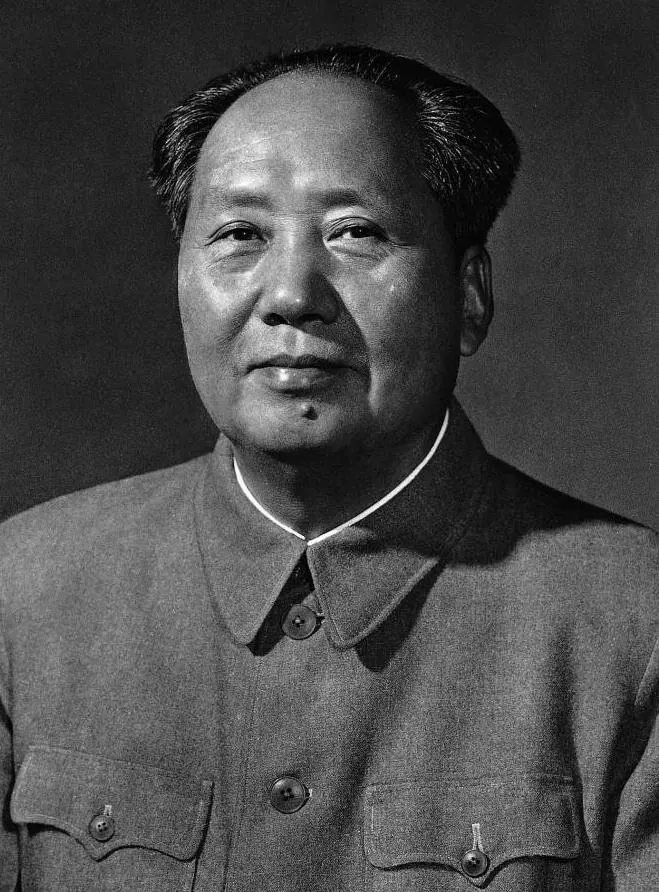
Mao Zedong, widely regarded as the 20th century's greatest mass murderer, passed away 50 years ago in September 1976. Despite his notorious reputation, Mao is still revered in communist China, with his images ubiquitous across the country. China's transformation since his death has been significant, and his ideology is no longer applied as it was during his rule. Mao's fanatical ideology led to the deaths of up to 75 million people, directly or indirectly.
Mao was a communist from the outset and one of the founders of the Communist Party of China in 1921. China's communist revolution was distinct from that in the Soviet Union, unfolding as a prolonged war within the country. Initially, communists and nationalist Kuomintang (KMT) forces collaborated to expel Japanese occupiers, only to engage in a civil war afterward. The communists ultimately prevailed, and the KMT, led by Chiang Kai-shek, fled to Taiwan. In 1949, Mao and his communists assumed power, proclaiming the establishment of the People's Republic of China.
Mao's early model was the Soviet Union under Josef Stalin, but relations cooled with Stalin's death in 1953 and the rise of Nikita Khrushchev. Mao promoted his own radical brand of communism, known as Maoism, which inspired radical leaders in the Third World. Like Stalin, Mao did not hesitate to enforce his ideology, eliminating perceived enemies, including the rural elite, military, administration, entrepreneurs, and independent farmers. He also purged the communist party, excluding and disadvantaging members who disagreed with him.
Mao's fixation on surpassing the Soviet Union economically led to disastrous consequences. He launched the "Great Leap Forward," setting unrealistic production targets and mobilizing people to achieve them. This resulted in widespread famine, with 25 to 50 million people dying. Mao initially denied responsibility, blaming alleged saboteurs within his party, but eventually, he relinquished power to more pragmatic party cadres. After a few years, Mao and his leftist supporters regained power, condemning cautious reforms as revisionism.
Mao's foreign policy was marked by shortsightedness and arrogance, particularly in relations with the Soviet Union. He dismissed Soviet advisors and engineers, convinced that he had all the answers. However, Mao did achieve a significant success with China's admission to the United Nations and the expulsion of Taiwan. His 1971 meeting with US President Nixon can also be seen as a breakthrough.
The final chapter of Mao's tumultuous rule was the "Great Proletarian Cultural Revolution," aimed at eradicating traditional and cultural elements. This movement, which lasted from 1966 to 1976, targeted young people, inciting them to view Mao as their messiah and denounce their parents, teachers, and authority figures. The consequences were devastating, with millions killed and cultural heritage destroyed. The fanatical Red Brigades eventually spiralled out of control, necessitating military intervention.
Following Mao's death, his wife and extremist allies attempted to continue his policies and the Cultural Revolution, but the more moderate faction regrouped and overcame the radicals. While reforms were introduced, and aspects of Mao's policies, including the Cultural Revolution, were criticized, Mao remains revered as a great leader in China.
Key points
- Mao's ideology led to the deaths of up to 75 million people.
- Mao's policies resulted in widespread famine and economic devastation.
- Mao's legacy continues to influence Chinese politics and society.