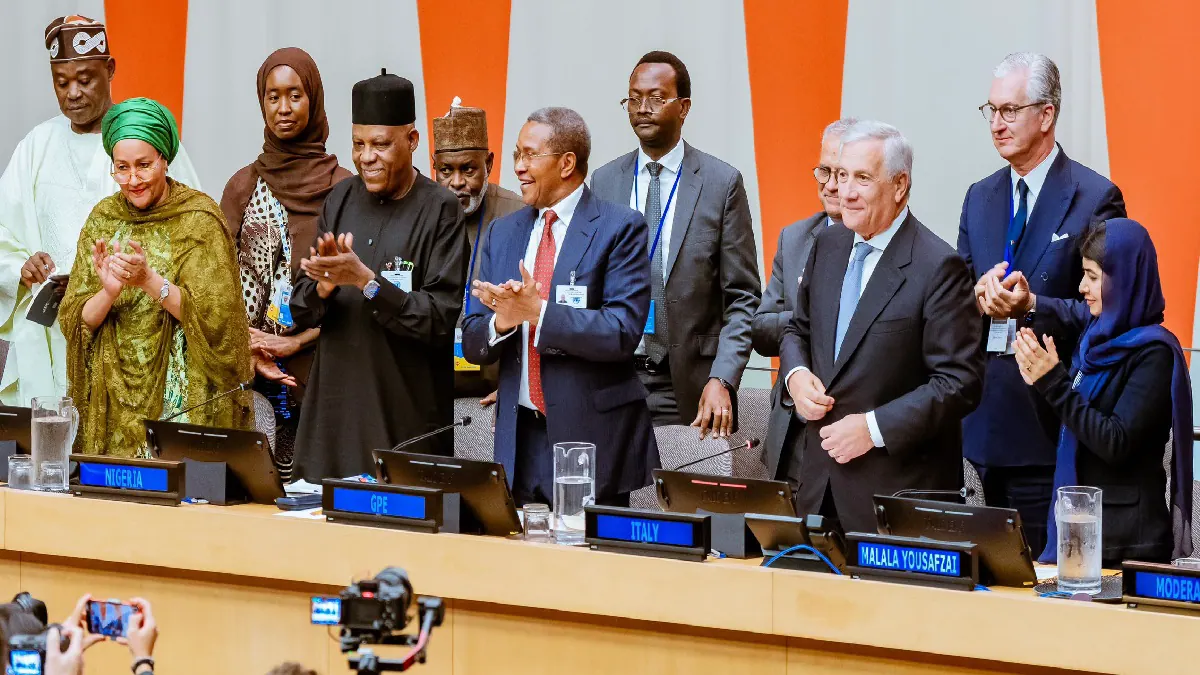
Global leaders and development partners have mobilised $3.5 billion in international commitments for education, as Nigeria and Italy took the lead in a renewed effort to close the financing gap confronting education systems and expand opportunities for hundreds of millions of children worldwide. The commitments were announced at the high-level “Multiply Possibility: A New Era for Education Financing” event held at the United Nations Headquarters in New York on the sidelines of the 81st United Nations General Assembly.
The event was co-hosted by Nigeria, Italy and the Global Partnership for Education (GPE) and brought together government leaders, development institutions, civil society organisations, philanthropic foundations and private-sector partners. The financing package includes $2.1 billion in confirmed and anticipated pledges from sovereign donors to GPE, as well as $1.4 billion in co-financing commitments from development finance institutions, philanthropic organisations and private-sector partners.
Nigeria’s role as co-host of the event places the country prominently in the international campaign to mobilise resources for education. Vice President Kashim Shettima represented Nigeria at the event and co-chaired the meeting with Italy’s Deputy Prime Minister and Minister of Foreign Affairs, Antonio Tajani. President Bola Tinubu, in a video message to the gathering, reaffirmed Nigeria’s commitment to education as a central pillar of national development and human-capital investment.
The 2026 budget provides ₦3.52 trillion for education, with the Federal Government describing education, skills, healthcare and social protection as central to its human-capital agenda. Nigeria has also been a GPE partner since 2012 and has prioritised accessible, equitable and inclusive foundational learning, including classroom construction, water and sanitation facilities and accelerated learning programmes for children who are out of school.
Beyond the international pledges, partner countries announced $471 billion in domestic education financing commitments, representing a projected 32 percent increase in education spending by 2030. The commitment is significant because the GPE campaign is built around the principle that international assistance should complement, rather than replace, domestic investment.
The GPE campaign is designed not only to raise additional international funding but also to leverage domestic resources and other forms of financing to strengthen education systems over the long term. According to GPE’s investment case for its 2026–2030 campaign, more than 270 million children are out of school, while conflict, instability, climate shocks and hunger continue to disrupt the education of millions more.
The partnership’s new campaign seeks to raise $5 billion and unlock a further $10 billion in co-financing to transform education systems and improve learning opportunities for about 750 million children in 96 countries. GPE estimates that the global learning crisis costs the world economy about $3.3 trillion annually in lost productivity, and a fully funded campaign could transform education systems and multiply opportunities for approximately 750 million children in 96 countries.
Key points
- Nigeria and Italy co-hosted the high-level Global Partnership for Education (GPE) financing event in New York.
- Global leaders and development partners have mobilised $3.5 billion in international commitments for education.
- The GPE campaign seeks to raise $5 billion and unlock a further $10 billion in co-financing to transform education systems and improve learning opportunities for about 750 million children in 96 countries.