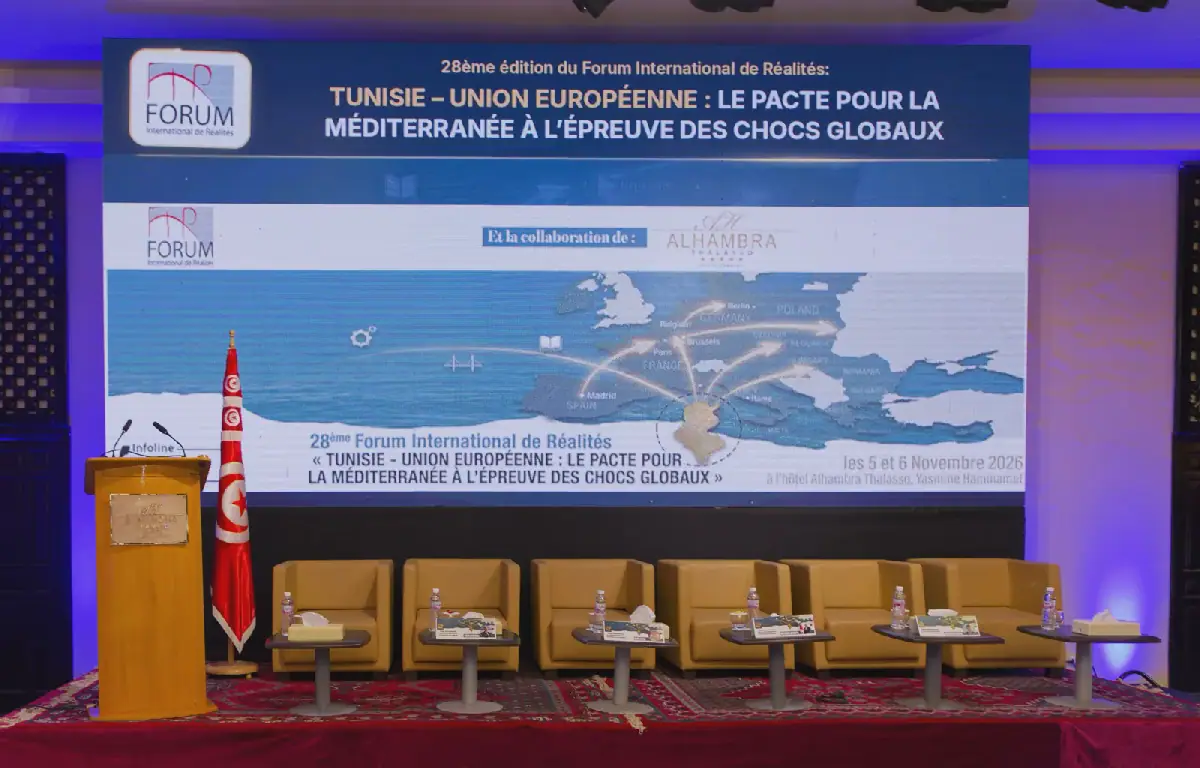
The 28th International Realities Forum, held in Tunisia, focused on the theme "Tunisia - European Union: The Mediterranean Pact in the Face of Global Shocks." The forum brought together experts and policymakers to discuss the future of the Mediterranean region. Kader Abderrahim, a research director at the Institute for Prospective and Security Studies in Europe, presented the main recommendations from the discussions. He emphasized that the Mediterranean's future cannot be considered independently of global geopolitical, economic, energy, and climate changes.
Abderrahim stressed that the Mediterranean region needs a strategy rather than just rhetoric about its importance. He advocated for a euro-tunisian relationship based on reciprocity, taking into account the interests, priorities, and ambitions of both parties. The partnership should prioritize economic development, including productive investments, job creation, industrial competitiveness, agricultural resilience, and integration into European and African value chains. The transitions to renewable energy and digitalization, as well as research and training, were also identified as key areas for cooperation.
The forum's discussions highlighted the need to recognize Tunisia as a strategic partner in its own right, rather than just a European periphery or a region for managing migration flows. Abderrahim argued that the relationship between the two sides of the Mediterranean should not be reduced to migration issues. While cooperation on security and border control is necessary, it should not overshadow student and professional mobility, researcher exchange, training, and qualification recognition.
Abderrahim also emphasized the importance of addressing the root causes of migration, including unemployment, territorial inequalities, and lack of prospects for young people. He called for a broader geopolitical perspective on the Mediterranean, integrating regional issues from the Maghreb, Sahel, sub-Saharan Africa, and the Middle East. Tunisia, he suggested, could play a key role in connecting Europe, the Maghreb, and Africa through regional cooperation and economic complementarity.
To give concrete effect to the new Mediterranean Pact, Abderrahim outlined three key requirements: coherence between economic, energy, migration, environmental, and security policies; reciprocity in defining partnership priorities; and tangible results through projects, financing, timelines, and evaluation mechanisms. He emphasized that the Mediterranean region has accumulated numerous declarations, summits, and initiatives, but now expects tangible achievements.
The forum's recommendations also stressed the need for a shift from a logic of neighborhood to a shared destiny. Abderrahim called for the Mediterranean to become a space for cooperation, circulation, knowledge, and shared prosperity, rather than a border between a protective North and a vulnerable South. The Pact's success, he argued, depends on its ability to deliver on these promises.
In conclusion, the 28th International Realities Forum highlighted the need for a new approach to euro-mediterranean partnership, one that prioritizes reciprocity, concrete results, and shared prosperity. The forum's recommendations offer a roadmap for a more strategic and mutually beneficial relationship between Tunisia and the European Union.
Key points
- The 28th International Realities Forum called for a new euro-mediterranean partnership based on reciprocity and concrete results.
- The partnership should prioritize economic development, including productive investments, job creation, and industrial competitiveness.
- The forum's recommendations emphasize the need to address the root causes of migration and to recognize Tunisia as a strategic partner in its own right.