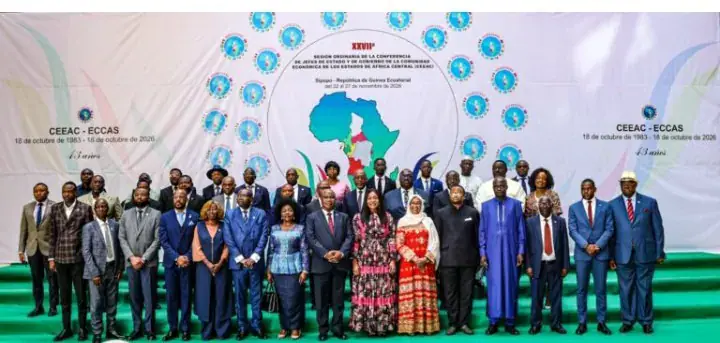
The 27th session ordinary session of the Conference of Heads of State and Government of the Economic Community of Central African States (CEEAC) is set to commence in Equatorial Guinea. Preparatory work for the conference involved several steps, including the Inter-State Committee of Experts (CIEE), which convened in Malabo on November 22, 2026. The CIEE examined technical dossiers, the Vision 2050, the 2026-2030 plan, community financing, rationalization of regional economic communities, and institutional evolution.
The Council of Ministers, presided over by Equatorial Guinea's Minister of Regional Integration, Rosario Mbasogo Kung, met on November 25, 2026, to prepare decisions for submission to the heads of state. Key issues on the summit's agenda include the effective withdrawal of Rwanda, announced during the 2025 summit, and the rotating presidency. The withdrawal follows tensions with the Democratic Republic of Congo (DRC) over the rotating presidency, which led to the extension of Equatorial Guinea's President Teodoro Obiang Nguema's mandate. Chad is expected to take over the presidency.
The CEEAC is focusing on consolidating gains from institutional reform, ensuring sustainable community financing, and advancing strategic frameworks, including Vision 2050 and the 2026-2030 plan. Discussions will also center on stability, cooperation, and economic integration in Central Africa. The regional body's efforts aim to enhance economic integration and address security challenges in the region.
The conference will assess progress on the CEEAC's institutional reforms and strategic plans. The Vision 2050 and 2026-2030 plan are designed to drive regional development and economic growth. The CEEAC comprises 11 member states and aims to promote economic integration, stability, and cooperation among its members.
The rotating presidency of the CEEAC has been a contentious issue, with tensions arising between member states. The presidency is expected to be transferred to Chad, following the withdrawal of Rwanda. The CEEAC's efforts to enhance regional integration and address security challenges will be closely watched by member states and international observers.
The conference will also discuss the rationalization of regional economic communities and institutional evolution. The CEEAC has been working to strengthen its institutional capacity and improve the effectiveness of its operations. The outcome of the conference is expected to have significant implications for regional integration and economic development in Central Africa.
The 27th CEEAC Conference of Heads of State and Government will conclude with a communiqué outlining the key decisions and outcomes. The conference is expected to provide a platform for member states to discuss regional issues and address common challenges. The CEEAC plays a critical role in promoting economic integration and stability in Central Africa.
Key points
- The conference agenda includes discussions on the withdrawal of Rwanda, the rotating presidency, and institutional reforms.
- The CEEAC is focusing on consolidating gains from institutional reform and advancing strategic frameworks.
- The outcome of the conference is expected to have significant implications for regional integration and economic development in Central Africa.