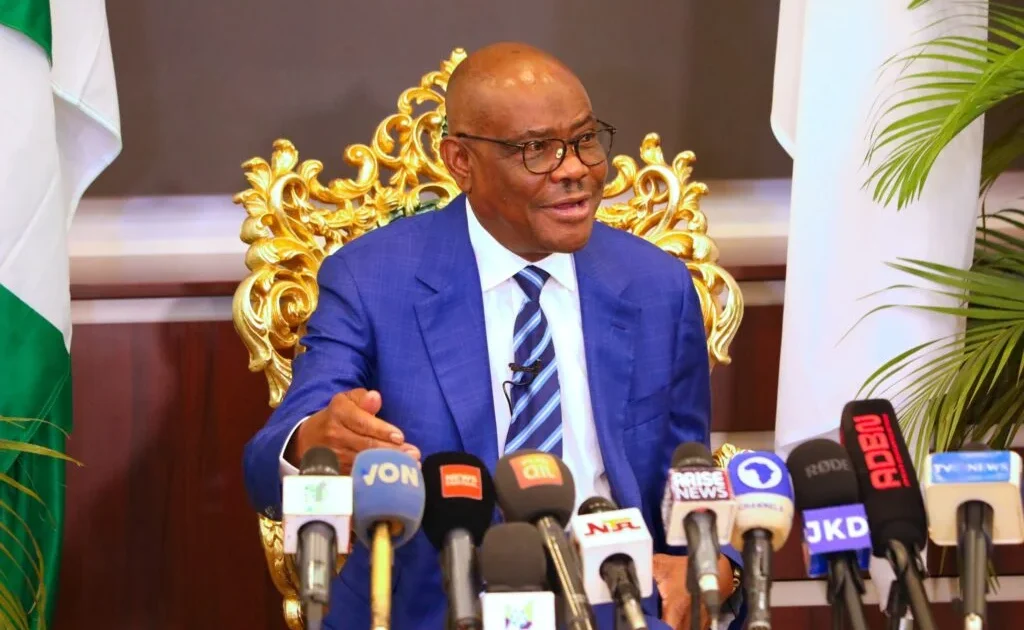
Nigerian Minister of the Federal Capital Territory, Nyesom Wike, has publicly defended the proposed Rainbow Coalition, aimed at mobilizing support for President Bola Tinubu's re-election in 2027. Wike dismissed concerns raised by some All Progressives Congress (APC) governors that the coalition could weaken the party. He emphasized that the coalition's primary goal is to support Tinubu's re-election, while allowing politicians to contest governorship and legislative elections on their respective party platforms.
Wike made these comments on TVC's Journalists' Hangout, responding to criticism from APC governors who declared they would not support any political alliance that could affect the party's candidates in the 2027 elections. Imo State Governor and Chairman of the Progressive Governors Forum, Hope Uzodimma, had stated that the forum would exclusively support APC candidates. Wike countered that supporting Tinubu for President did not mean abandoning candidates of other parties in governorship and legislative elections.
The Minister of the Federal Capital Territory alleged that the opposition of some APC governors to the coalition was driven by their political interests, particularly attempts to influence the emergence of the next Senate President and Speaker of the House of Representatives. He specifically mentioned Uzodimma, accusing him of positioning himself to become Senate President after leaving office. Wike's comments have reignited the debate on the implications of the Rainbow Coalition for Nigeria's politics.
Wike cited the experience of the G5 governors during the 2023 elections, saying members of the group supported Tinubu for President while their parties retained their candidates for other elective positions. He argued that a similar arrangement could operate in 2027, with politicians supporting Tinubu for President while backing candidates of their preferred parties in governorship and legislative contests. This approach, Wike claimed, would not confuse voters, as Nigerians had previously demonstrated their ability to vote across party lines.
The FCT minister also addressed concerns that some APC governors were trying to influence the composition of the next National Assembly to determine who would emerge as its presiding officers. He alleged that these governors feared politicians denied APC tickets could defect to other parties, win elections, and subsequently refuse to support their preferred candidates for Senate President or Speaker. Wike directly addressed Uzodimma's reported ambition to become Senate President, stating he would not support him for the position.
Wike insisted that his primary objective was to secure Tinubu's re-election, which he would achieve by campaigning on the administration's record. He cited the President's support for state police and the devolution of resources and powers to sub-national governments as key issues to highlight in making a case for Tinubu's re-election. Wike also dismissed reports that Tinubu had agreed to concede nine states to the PDP or the Rainbow Coalition as part of a political arrangement.
The developments have underscored the complexities of Nigeria's politics as the 2027 elections approach. Wike's stance on the Rainbow Coalition and his disagreements with APC governors reflect the intricate alliances and rivalries shaping the country's political landscape. As the situation continues to unfold, Nigerians will be watching closely to see how these dynamics impact the future of the country's governance.
Key points
- Wike dismisses concerns over Rainbow Coalition's impact on APC.
- The coalition aims to support Tinubu's re-election while allowing parties to field candidates in other elections.
- Wike and APC governors have differing views on the coalition's implications for Nigeria's politics.