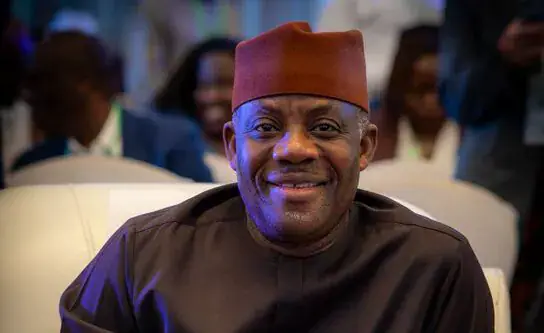
Nigeria's Minister of Education, Tunji Alausa, has expressed confidence in President Bola Tinubu's performance, advocating for his re-election in 2027. Alausa highlighted Tinubu's achievements, stating that the President has transformed various sectors in Nigeria. He cited significant economic improvements, including over $55 billion in foreign reserves and a stabilized exchange rate. According to Alausa, these accomplishments demonstrate Tinubu's capability to lead Nigeria effectively.
Alausa appeared on Channels Television's Politics Today programme, where he emphasized Tinubu's achievements. The Minister noted that Nigeria's GDP has grown by almost 4.43 per cent quarter over quarter. Additionally, he mentioned that states have been able to pay salaries, indicating improved financial stability. While praising the administration's efforts, Alausa acknowledged that many Nigerians continue to face challenges due to the administration's policies.
Despite the economic gains touted by officials, residents have staged protests to express their dissatisfaction. In his Independence Day address, President Tinubu acknowledged the economic strain citizens are facing. He recognized that the reforms implemented have had difficult side effects but argued that the administration's goal was to correct Nigeria's course. Tinubu's efforts to address the country's challenges have been met with mixed reactions.
Alausa highlighted the education sector's progress under Tinubu's administration. He claimed that the renewed hope agenda has "delivered 100 per cent" in the education sector. The Minister listed several educational policies, including the student loan scheme and the Inspired Live initiative. These initiatives aim to improve access to education, particularly in remote areas.
The Minister of Education also mentioned the Federal Ministry of Education's Technical and Vocational Education and Training (TVET) Initiative. He stated that over 500 billion has been injected into the economy through stable tertiary education. Additionally, Alausa noted that the Nigerian Education Loan Fund has almost N370 billion, with about N192 billion in student stipends. These investments aim to support students and improve the education system.
However, the issue of out-of-school children remains a challenge in Nigeria. Alausa disputed UNICEF's estimate of 15-17.5 million out-of-school children, citing a lack of updated census figures. Instead, he projected that Nigeria has only eight million out-of-school children. According to Alausa, 1.2 million children have been taken off the streets through multi-layer interventions. The National Bureau of Statistics is set to conduct a general household survey to determine the actual number of out-of-school children.
School abductions have disrupted school calendars in various parts of Nigeria during President Tinubu's administration. Recent incidents include the abduction of 25 schoolgirls in Kebbi State and 265 students and staff members in Niger State. These attacks have led to the closure of schools and concerns about student safety. The federal government and state governors have responded to these incidents, but the issue of school abductions remains a significant challenge.
Key points
- - President Tinubu's administration has achieved significant economic improvements, including over $55 billion in foreign reserves. - The education sector has seen progress, with initiatives like the student loan scheme and TVET. - School abductions remain a major challenge, with over 2,000 students abducted in roughly 30 mass kidnapping incidents.