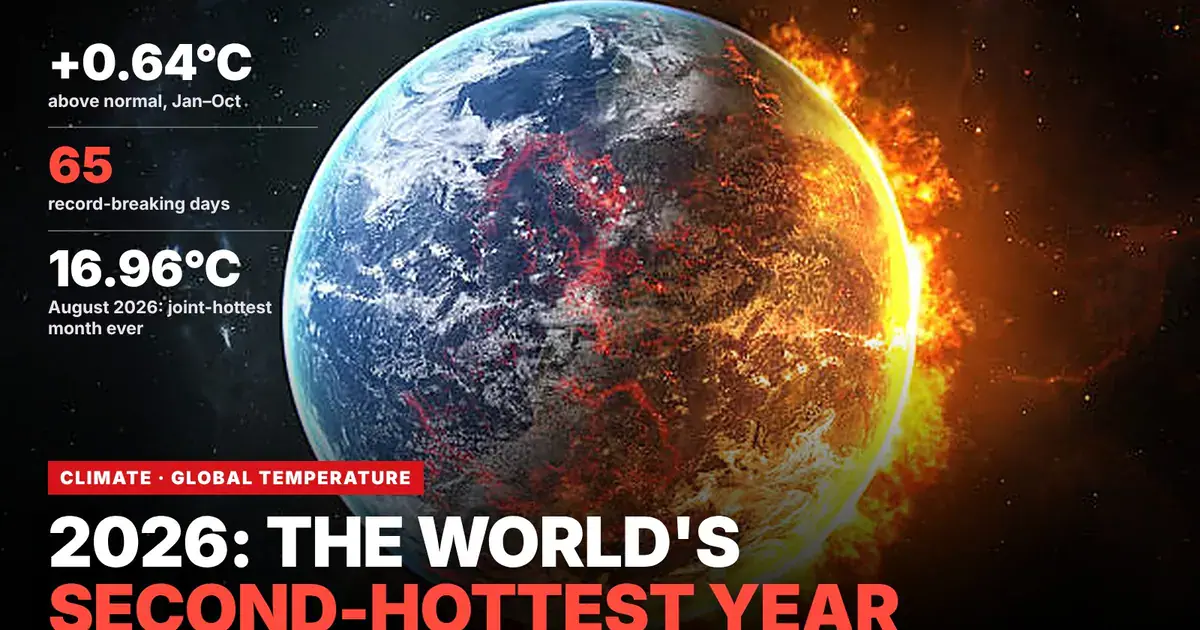
The world has experienced an unusually hot year in 2026, with the average air temperature at the Earth's surface reaching 15.30°C between January 1 and October 26. This represents a 0.64°C increase above the average for the same period between 1991 and 2020. According to an analysis by JoyNews Research, using data from the European Centre for Medium-Range Weather Forecasts, 2026 is currently the second-warmest year on record, behind only 2024.
The El Niño climate pattern, which began in August, has contributed significantly to the rising temperatures. El Niño is a natural phenomenon where the surface of the Pacific Ocean near the equator becomes unusually warm, releasing extra heat into the air and raising temperatures globally. The US National Oceanic and Atmospheric Administration reported that El Niño conditions were present on October 8, with a key Pacific temperature index at 2.1°C above normal.
August 2026 was particularly notable, as it became the warmest August on record, with an average temperature of 16.96°C. This beats the previous record, shared by 2024 and 2023, by 0.13°C. September was also the second-warmest on record, behind only 2023. October is currently running just 0.01°C ahead of the same period in 2023, but the final figures are yet to be confirmed.
The impact of these rising temperatures is evident in the number of record-breaking days. So far in 2026, there have been 65 record-breaking days, with 24 of those occurring in August alone. From August 8 to September 8, every single day set a new record for its date, with 32 consecutive days of record-breaking temperatures.
The consequences of these temperature increases are far-reaching. In Ghana, the Ghana Meteorological Agency has forecast warmer-than-normal temperatures and below-normal to normal rainfall in most areas during the September to November minor rainy season. The agency has advised farmers to prepare for long dry spells by harvesting rainwater and using drought-tolerant and early-maturing crop varieties.
The global implications of these rising temperatures are also significant. Under the 2015 Paris Agreement, countries agreed to try to keep global warming to 1.5°C above pre-industrial levels. However, 2026 is projected to end at around 1.55°C above pre-industrial levels. While this does not mean the Paris limit has been broken, it highlights the need for urgent action to address climate change.
As world leaders prepare to meet in Antalya, Türkiye, for the COP31 climate summit, the data emphasizes the need for accelerated efforts to mitigate the effects of climate change. The four hottest years on record are projected to be 2023, 2024, 2025, and 2026. The rate of warming has also accelerated, with the world warming by 0.14°C every ten years since 1940, and 0.29°C per decade since 2000.
Key points
- 2026 is projected to be the second-hottest year on record, driven by the El Niño climate pattern.