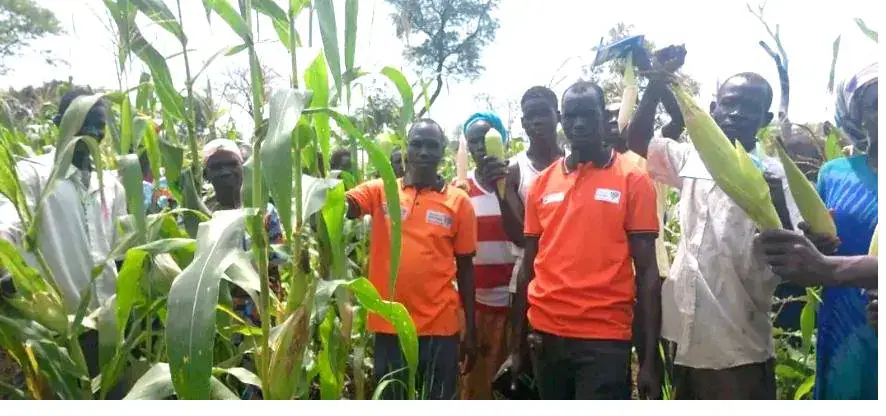
At least 200 vulnerable households in Torit County, Eastern Equatoria State, have received agricultural production assistance aimed at strengthening household food security and improving livelihoods through climate-resilient farming practices. The support was provided in August this year in Iyire Payam, specifically in Nyara and Balbal Bomas. This initiative is part of broader efforts to strengthen the resilience of conflict-affected communities.
The emergency project officer, Benson Onek, expressed satisfaction with the progress made, saying the intervention was designed to help vulnerable households recover their livelihoods following conflict and displacement in late 2025. Onek explained that the targeted beneficiaries were households severely affected by conflict in Torit County. The project focused on equipping farmers with practical skills and resources to improve agricultural production despite changing climatic conditions.
The assistance included training on Climate-Smart Agriculture (CSA) practices and improved access to climate-resilient seeds to strengthen farmers’ capacity to withstand climate-related challenges. Onek said that the support did not stop at training and the distribution of agricultural inputs. Farmers were also regularly followed up in their fields to encourage the adoption of climate-smart agriculture practices and provide timely, field-based extension support.
Paska Akongo, the Interim Director for Sustain Initiative South Sudan, noted that despite the prolonged drought conditions experienced across Eastern Equatoria State this year, farmers in most of the project’s targeted areas remain optimistic about achieving good harvests. Akongo observed that farmers, particularly in Magwi and Torit counties, are hopeful that their agricultural production will provide sufficient food for household consumption.
Akongo encouraged the beneficiaries to remain committed to farming and make effective use of the agricultural support provided, despite the moderate rainfall experienced in some parts of the state and project locations. The initiative aims to improve household food security and promote sustainable livelihoods through climate-smart agricultural production. This support will enable farmers to generate income from surplus produce.
The project’s impact is expected to be significant, given the challenges faced by farmers in the region. Climate-related challenges have affected agricultural production in Eastern Equatoria State, and this initiative seeks to address these issues. By providing climate-resilient seeds and training on CSA practices, the project aims to enhance the resilience of conflict-affected communities.
The agricultural assistance provided to 200 vulnerable households in Torit County is a significant step towards strengthening household food security and improving livelihoods. The project’s focus on climate-resilient farming practices will enable farmers to adapt to changing climatic conditions and improve their agricultural production. Key points include:
Key points
- The project provided training on Climate-Smart Agriculture (CSA) practices and improved access to climate-resilient seeds.
- 200 vulnerable households in Torit County received agricultural assistance to improve food security and livelihoods.
- The initiative aims to strengthen the resilience of conflict-affected communities and promote sustainable livelihoods through climate-smart agricultural production.