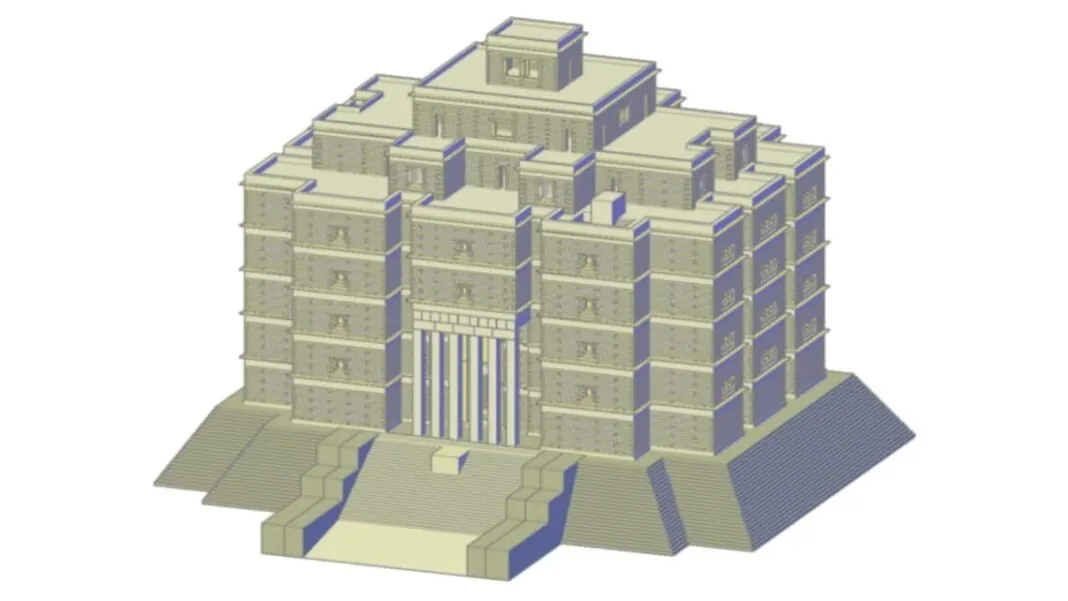
A recent structural engineering study has shed new light on the historical site of Yeha in northern Ethiopia. The research focused on Grat Be’al Gibri, a monumental palace site dating back to the early first millennium BCE. The study found that the 2,800-year-old palace had incredible structural strength, capable of supporting a building up to 16 storeys high. This challenges previous estimates of the building's original height.
The research team, led by Martin Drieschner and Mike Schnelle, used advanced modeling techniques to examine the palace's structural elements. They constructed sophisticated three-dimensional simulations of a wall corner and a doorway. The team tested a broad spectrum of possible stiffness and strength parameters for both the ancient stonework and the timber reinforcements. This approach allowed them to assess the palace's structural capacity.
The palace's original construction relied on a meticulous mix of quarry stone, clay mortar, and horizontal wooden beams embedded within the masonry. This timber-reinforced technique formed systematic horizontal layers, distinct from contemporary building traditions in South Arabia. Archaeological indicators had long pointed to a multi-level structure, including podium walls and a surviving southeast staircase.
Previous virtual reconstructions had hypothesized a structure of eight floors. However, Drieschner and Schnelle's simulations indicate that the ancient builders achieved an extraordinary structural safety margin. The models yielded load factors that comfortably supported a 16-storey structure, doubling previous height estimations. The study's findings offer fresh structural validation for the physical remains at Yeha.
The research identified the clay-mortared stonework as the primary determinant of structural performance. Variations in the ancient timber had a negligible impact on overall load resistance, whereas tension within the clay mortar layers constituted the main failure mechanism in the models. The uniform performance of the tested wall sections points to an advanced, highly efficient system for weight distribution.
The study also revealed that if the builders had tapered the walls to be thinner on upper levels, the structural capacity of the lower storeys would have been amplified further. Archaeological evidence indicates that Grat Be’al Gibri ultimately fell to a major, catastrophic fire. The new structural data confirms that ordinary operational loads could never have compromised the building's integrity.
The findings highlight an elite level of pre-Aksumite engineering sophistication that reached far higher than modern science previously understood. The research provides new insights into the engineering capabilities of ancient Ethiopian civilizations. The study's results have significant implications for our understanding of the development of architecture and engineering in the region.
Key points
- The 2,800-year-old Grat Be’al Gibri palace in Yeha, Ethiopia, could have stood 16 storeys high.
- The palace's structural strength was due to its unique construction, which included a mix of quarry stone, clay mortar, and horizontal wooden beams.
- The study's findings challenge previous estimates of the building's original height and highlight the advanced engineering capabilities of ancient Ethiopian civilizations.