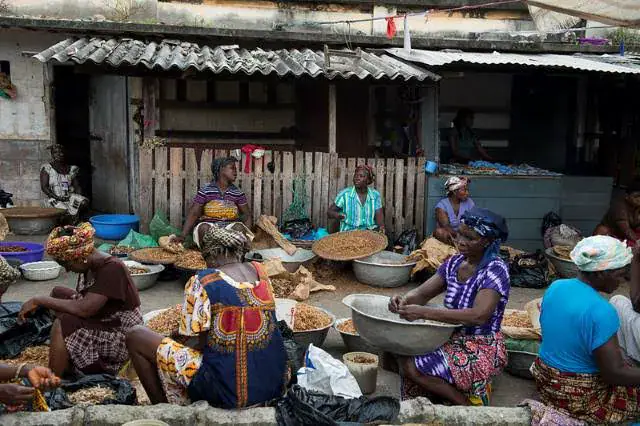
According to the Ghana Statistical Service (GSS), approximately 2.69 million people in Ghana lived in vulnerable households during the third quarter of 2026. The GSS's Mobile Vulnerability Analysis and Mapping (mVAM) survey sampled 7,752 households between July and September 2026. The report revealed that 93.5 per cent of households had acceptable food consumption, while 6.6 per cent faced borderline or poor consumption. This translates to about 606,000 households struggling with food insecurity.
The survey highlighted significant regional disparities in food insecurity. The North East Region recorded the highest rate of vulnerable food consumption at 42.2 per cent, followed by the Upper East Region at 30.1 per cent and the Upper West Region at 29.5 per cent. Additionally, the survey found a stark urban-rural divide, with 10.7 per cent of rural households affected compared to 3.8 per cent in urban areas. Education levels of household heads also played a significant role in food security.
The GSS report emphasized that food consumption figures alone do not capture the full extent of household pressure. Medium or high short-term food coping strategies affected 30.1 per cent of households, or about 2.79 million people. Furthermore, 11.3 per cent of households, or about 1.05 million, resorted to crisis or emergency livelihood strategies that can harm future well-being. This indicates that many households are making difficult choices to maintain their diets, which may not be sustainable.
Economic pressure is widespread, with 50.5 per cent of households, or about 4.69 million people, spending more than three-quarters of their total expenditure on food. This leaves limited resources for health, education, and housing. About 22.6 per cent of households experienced a time in the previous month when they could not reach a market. These findings suggest that households are struggling to make ends meet.
The survey also found that assistance to households is low. Only 0.9 per cent of households, or about 83,000 people, received assistance in the month before the interview. This is low compared to the 11.3 per cent of households using crisis or emergency livelihood coping strategies. The report supports calls for a review of coverage, targeting, and delivery of assistance to vulnerable households.
The GSS tracked a balanced panel of 5,050 households across four quarters and found that vulnerability is not always temporary. While 82.1 per cent of panel households never had vulnerable food consumption, 17 per cent experienced it in some quarters, and 0.9 per cent experienced it in every quarter. Chronic vulnerability was higher among rural households and those in several northern regions.
The report recommends early and targeted action to address food insecurity. The government and local authorities are urged to use food consumption, coping, market access, and repeated vulnerability data in early-warning and targeting systems. Prioritizing high-risk regions in social protection programmes and investing in resilient agriculture, storage, transport, and food value chains can help reduce structural risk and support vulnerable households.
Key points
- 2.69 million Ghanaians faced food insecurity in Q3 2026
- Food insecurity is highest in North East, Upper East, and Upper West regions
- Low levels of assistance to vulnerable households exacerbate food insecurity
Reporting sources
- 2.69 million Ghanaians faced food insecurity in Q3 2026 – GSS... · Daily Graphic