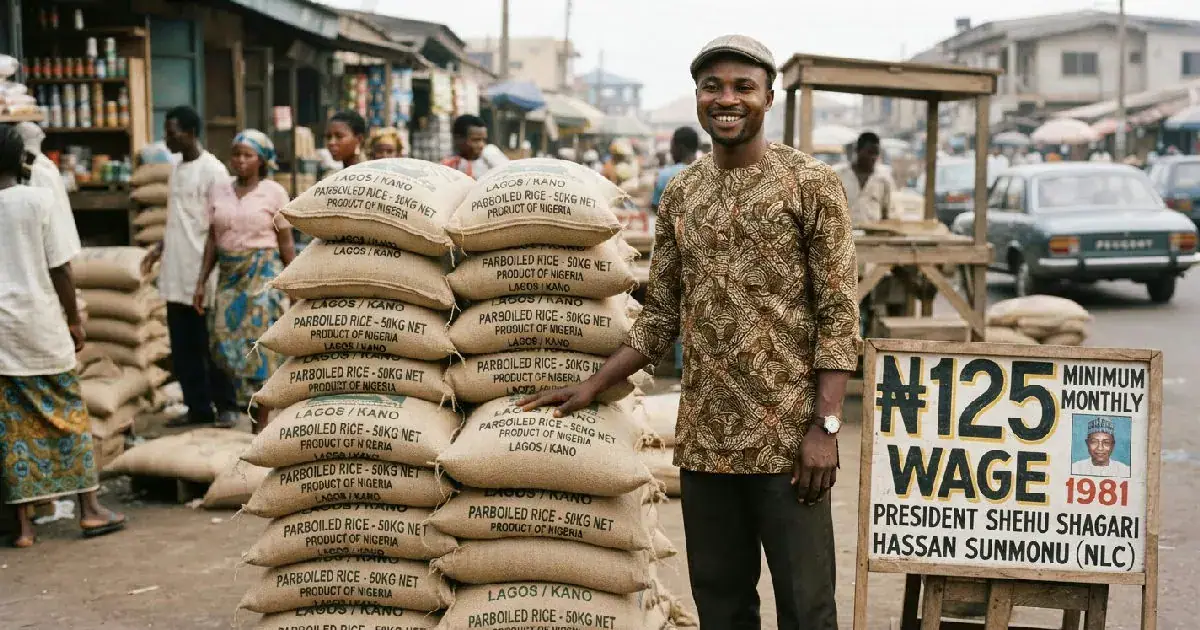
In 1981, Nigeria's economic landscape was vastly different from what it is today. A worker earning the national minimum wage of ₦125 could buy 25 bags of rice with their monthly salary. This historical snapshot reveals a time when a worker's earnings stretched considerably further, providing a level of financial security that has since eroded. The ₦125 wage was a significant milestone in Nigeria's labour history, marking a formal establishment of a national minimum wage.
The journey to the ₦125 minimum wage was a long one. Before 1981, Nigeria lacked a formal, structured national minimum wage. The Nigeria Labour Congress (NLC), formed in 1978, became the primary voice for workers' rights. Under the leadership of its pioneer President, Comrade Alhaji Hassan Adebayo Sunmonu, the NLC aggressively championed the cause for a national minimum wage. Workers initially demanded a much higher monthly minimum wage of ₦300, but President Shehu Shagari's administration ultimately reached an agreement with labour leaders.
The National Minimum Wage Act was officially enacted on September 3, 1981, legally establishing the ₦125 wage as the statutory minimum for a large segment of the Nigerian workforce. This period allowed ordinary households to stretch their earnings, covering food, shelter, and other family responsibilities with greater ease. The financial security experienced by workers then stands in sharp contrast to later decades.
A single bag of rice cost just ₦5 in 1981. This price point, combined with the ₦125 monthly minimum wage, meant a worker could purchase a remarkable 25 bags of rice. This comparison vividly illustrates the immense purchasing power of the naira at that time. Beyond rice, a monthly income of ₦125 provided a foundation for a comfortable life for many working families.
The decades following 1981 witnessed profound transformations in Nigeria's economic landscape. Factors like persistent inflation, currency depreciation, and escalating food prices gradually eroded the buying power of the average Nigerian worker. While nominal minimum wages increased over time, the rising cost of essential goods and services often outpaced these adjustments.
The price of rice offers a stark illustration of this economic shift. By 1990, a bag of rice had climbed to ₦350. Just four years later, in 1994, it spiked dramatically to ₦1,800, influenced by new government duties aimed at boosting local production. The naira's devaluation in 1999 pushed a 50kg bag of rice to ₦2,500. By 2008, global food crises and import duties further inflated prices to ₦9,000.
The trend continued relentlessly, with a 50kg bag of rice averaging ₦8,500 in 2015, soaring to ₦26,000 by 2020, and further to ₦32,000 in November 2021. By December 2023, the price had reached ₦47,000. Early 2024 saw prices for a 50kg bag between ₦95,000 and ₦105,000, with a 25kg bag costing ₦35,000. As of October 2026, an imported 50kg bag of long-grain rice retailed for ₦53,000 in Lagos, while local varieties were even higher.
Key points
- The ₦125 minimum wage in 1981 had significant purchasing power, allowing workers to buy 25 bags of rice.
- The erosion of the naira's purchasing power has had a profound impact on Nigerian workers, with the price of rice increasing exponentially over the years.
- The comparison between Nigeria's 1981 economic reality and its present-day situation offers a critical lens through which to understand the nation's economic development and the evolving security of its workforce.