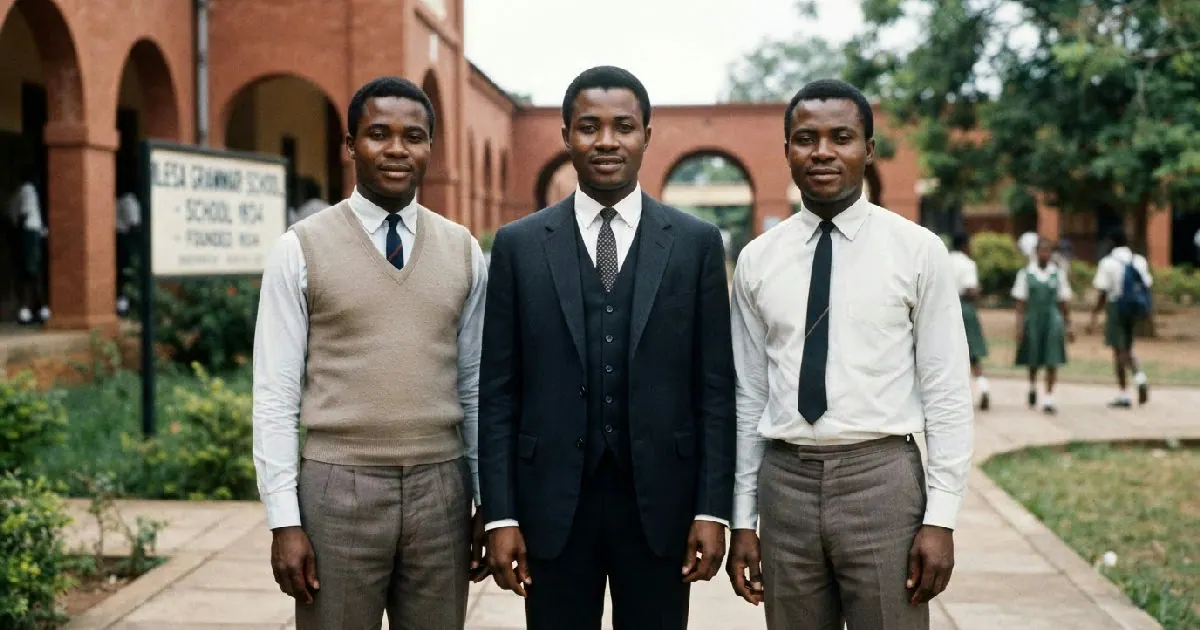
A 1968 photograph of teachers at Ilesa Grammar School in Nigeria has provided a unique glimpse into the transformative era of post-independence Nigeria. The image features Dr. Victor Omololu Olunloyo, then Western State Commissioner for Education, with teachers Niyi Fakulujo and John Obasola Omole. These individuals, who began their careers as educators, went on to achieve great success in their respective fields. Their stories challenge common assumptions about career trajectories in Nigeria during a period of intense political and social change.
Ilesa Grammar School, established on February 5, 1934, had already become a pillar of Western Nigerian education by the time the photograph was taken. The school, which began with 21 boys, was made possible by the efforts of the Egbe Atunluse Ile Ijesa, the Ijesa Improvement Society. Their campaign for a secondary school in Ijesaland culminated in its opening, highlighting the crucial role of community initiatives in colonial Nigeria's educational development. The school operated for over three decades, shaping generations of young minds before Dr. Olunloyo's visit.
Niyi Fakulujo, one of the teachers in the photograph, transitioned from teaching to the Nigerian Army, where he achieved the rank of Colonel. He was appointed Commandant of the Nigerian Military School in Zaria from September 1985 to October 1990. Fakulujo's journey from educator to military leader demonstrates the diverse avenues of service available to educated Nigerians. His story illustrates how intellectual rigor fostered in educational settings can be reapplied to demanding leadership roles within the armed forces.
John Obasola Omole, another teacher in the photograph, chose a different path, transitioning into book publishing. His shift highlights the interconnectedness of education and the emerging knowledge industry in Nigeria. As a teacher, Omole contributed to classroom instruction, and his move into publishing allowed him to influence the materials that informed and educated countless students across the nation. Omole's transition underscores the professional mobility of educators and their potential to contribute to national development in various ways.
The 1968 visit by Dr. Olunloyo to Ilesa Grammar School occurred during a tumultuous period in Nigeria's history, marked by the Nigerian Civil War and a massive reorganization of the country's governmental structure. As Western State Commissioner for Education, Dr. Olunloyo was responsible for standardizing education and promoting academic excellence in private secondary schools. His leadership ensured that educational institutions continued to function, providing a semblance of normalcy and hope for the future.
Dr. Victor Omololu Olunloyo himself embodied the multi-faceted career paths common among Nigeria's early elite. A distinguished mathematician, he earned his doctorate from the University of St Andrews in Scotland and quickly transitioned into public service. At 27, he became a commissioner in the Western Region, serving under Dr. Moses Majekodunmi. He held multiple commissioner appointments, including education, under Colonel Robert Adeyinka Adebayo in Western State.
The photograph of Ilesa Grammar School teachers serves as a testament to the diverse career paths available to educated Nigerians during a period of significant change. Dr. Olunloyo's blended career path, which combined academic achievement and administrative responsibility, was a hallmark of his career. His legacy, along with that of Fakulujo and Omole, demonstrates the fluidity between academic, administrative, and political leadership in post-independence Nigeria.
Key points
- The 1968 photograph of Ilesa Grammar School teachers reveals the future careers of Niyi Fakulujo, who became a Nigerian Army Colonel, and John Obasola Omole, who transitioned into book publishing.
- Ilesa Grammar School, established in 1934, played a significant role in Western Nigerian education, shaping generations of young minds.
- Dr. Victor Omololu Olunloyo, a distinguished mathematician, embodied the multi-faceted career paths common among Nigeria's early elite, combining academic achievement and administrative responsibility.