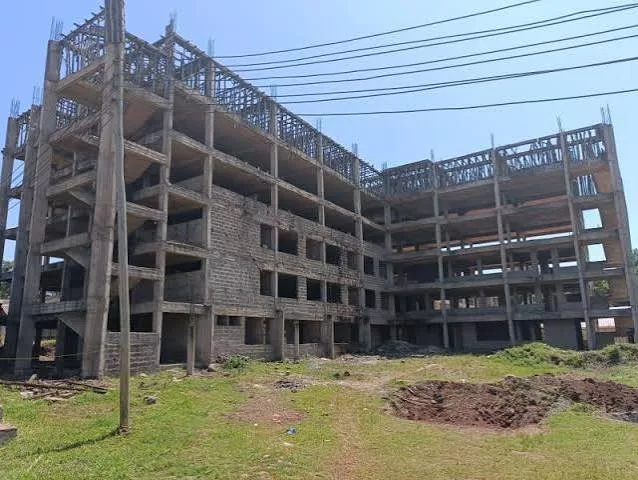
A total of 189 county development projects worth Sh10.51 billion have stalled across Kenya, leaving residents waiting for vital services such as hospitals, roads, and markets. The projects, which range from hospitals and roads to water schemes, markets, and social halls, were launched to promote devolution and improve the lives of citizens. However, years after their inception, the buildings remain incomplete, contractors have walked away, and residents are still waiting.
According to the report by Controller of Budget Margaret Nyakang’o, counties had paid Sh4.21 billion towards the stalled projects before they ground to a halt. Nairobi has the highest number of stalled projects, with 57 projects valued at Sh2.24 billion. Kakamega has 26 projects worth Sh848.95 million, while Baringo has 23 projects valued at Sh163.32 million. The report cites various reasons for the stalled projects, including inadequate budgetary allocations, unresolved contract variations, contractor abandonment, and contract termination.
In Nairobi, some projects had moved significantly towards completion before running out of steam. A medical block at Mbagathi Hospital, valued at Sh255.87 million, was only 15 per cent complete. At Mwiki, a Sh76 million social hall remains stalled after the contractor left the site due to non-payment. In Dandora II, a youth complex valued at Sh50 million is also incomplete. The rehabilitation of Makina market, estimated at Sh42 million, has similarly stalled due to non-payment of the contractor.
The stalled projects have significant implications for residents who were expecting better health services, safer trading spaces, and facilities for young people. In Machakos, 22 stalled projects have been reported, with Sh314.26 million already paid out of their total estimated value of Sh891.58 million. At Mua, a community hospital valued at Sh11.53 million had reached 80 per cent completion before the work stopped. Despite being close to completion, the facility remains non-functional.
Nyakang’o has recommended that counties prepare verified schedules of all stalled projects and develop time-bound recovery plans. She also advised counties to prioritize projects that can be completed and operationalized, allocate sufficient resources, and resolve contractual disputes promptly. The report also notes that shifting political priorities is one of the factors behind stalled projects, leaving communities waiting even after a project has consumed public funds.
The human cost of the stalled projects is visible in various counties. In Kakamega, 26 projects worth Sh848.95 million have stalled, with Sh218.98 million already paid. One of the projects is the Ingotse-Navakholo-Chebuyusi road, valued at Sh100 million, which was only 40 per cent complete when its contract was terminated. In Nakuru, three projects worth Sh60.65 million have stalled after Sh40.93 million was paid. A fish market in Naivasha, valued at Sh9.66 million, was 50 per cent complete when work ground to a halt.
The stalled-project crisis exposes weaknesses in county planning, funding, and contract management. With Sh10.51 billion tied up in 189 projects and Sh4.21 billion already paid, residents are bearing the cost through delayed hospitals, markets, roads, and other services. The controller has asked counties to ring-fence projects under investigation and pursue appropriate recovery, enforcement, or corrective actions where loss or irregularity is established.
Key points
- 189 county development projects worth Sh10.51 billion have stalled across Kenya.
- Sh4.21 billion has already been paid towards the stalled projects.
- Counties have been advised to prioritize projects that can be completed and operationalized, and allocate sufficient resources to complete them.