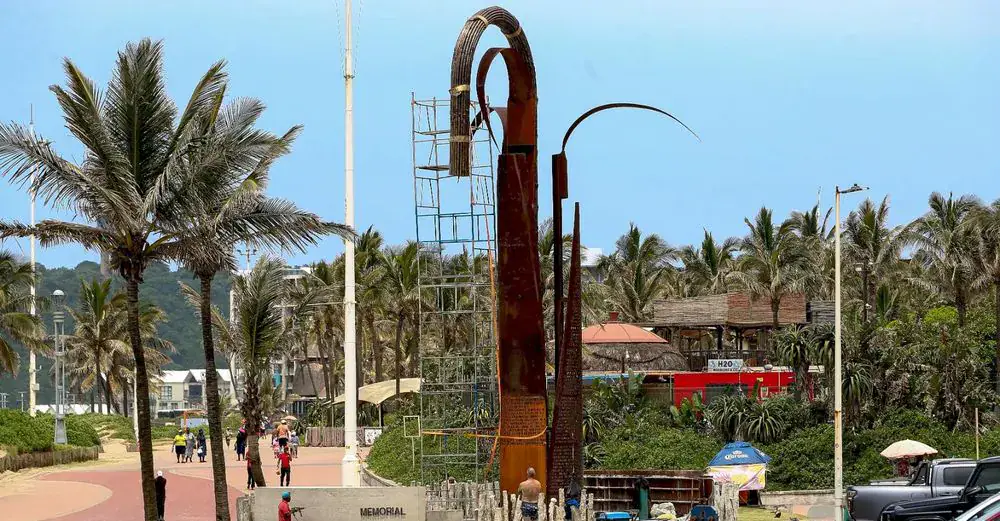
A memorial commemorating the arrival of Indian indentured labourers in South Africa will not be ready for the 166th anniversary of their arrival on November 16. The project, initially allocated R10 million 16 years ago, is now expected to be completed by September 2027. The continued delays have raised questions about planning, funding, and accountability. Community members are questioning why a project intended to preserve an important chapter of South Africa's history has taken so long to materialize.
On November 16, 1860, the SS Truro arrived in Durban, then known as Port Natal, carrying the first Indian indentured labourers from Madras, now Chennai. Their arrival marked the beginning of Indian indenture in South Africa. The monument, initially designed as an Arch of Unity with a bell tower, was redesigned after objections. A bronze sculpture depicting an indentured couple and their child will now form part of the memorial. The design concept includes a bronze sculpture of an indentured couple with a child, which will be placed on a plinth along with the Arch of Unity.
Selvan Naidoo, designer of the 1860 Indentured Workers Memorial, said the project was being completed in two phases. Phase one focused on completing the Arch of Unity, and phase two included the indentured bronze couple. While phase one was nearing completion, phase two faced funding challenges, resulting in the delay. The KwaZulu-Natal Department of Sport, Arts and Culture approached various members of the public sector, securing only R100 000 to pay for the indentured bronze couple.
In September, the KZN government committed to paying R2.7 million for the indentured bronze couple, and the process is currently underway. Naidoo said the armature and clay work for the sculpture were already in place, but foundry work could take up to seven months. The department plans to unveil the monument when both phases are completed. Interactive panels with historical information are being erected for phase one, which is expected to be completed by Friday.
The revised timeline has resulted in mixed emotions among the community. Seelan Achary, who chaired the initial monument committee, said the delays undermined the significance of the project. Achary urged the Premier of KZN, Thami Ntuli, to respect the community's wishes and act with urgency. A permanent monument paid for by the government would show respect and honor the contribution of the Indian community.
Prince Ishwar Ramlutchman Mabheka Zulu, president of the Sivananda World Peace Foundation, said the community had already waited too long for the monument. The project was promised for the 150th anniversary in 2010, and 16 years have passed since then. While it's understood that a monument of this significance cannot be rushed, what matters is that it's done properly, with dignity, and with the correct representation of history.
Community leaders and activists have expressed their concerns and expectations regarding the monument's completion. Anand Jayrajh, president of the 1860 Indentured Labourers Foundation, said it would be better late than never, but if the delay is due to negligence, it needs to be investigated. Tholsi Mudly, a historian, expressed sadness over the delay, and Jay Jugwanth, a community activist, demanded transparency and accountability from the authorities.
Key points
- The 1860 Indian indenture memorial in South Africa has been delayed for 16 years and is now expected to be completed by September 2027.
- The project has faced funding challenges, with only R100 000 secured initially, and the KZN government committing R2.7 million in September.
- Community leaders and activists have expressed concerns and expectations regarding the monument's completion, emphasizing the importance of transparency, accountability, and respect for the community's wishes.