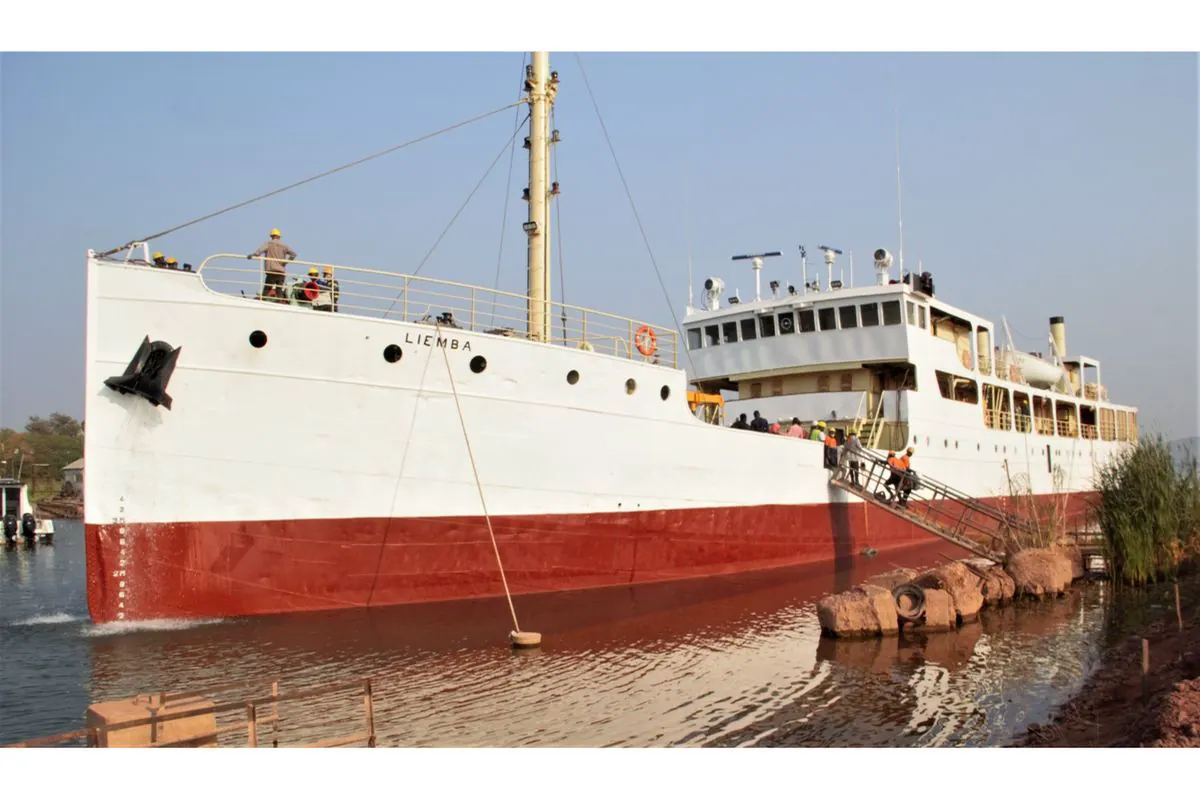
Tanzania's historic passenger vessel MV Liemba has returned to Lake Tanganyika following a Sh34 billion overhaul. The vessel, which began its first post-refurbishment voyage on the night of October 6, 2026, departed Kigoma Port for Kalemie in the Democratic Republic of Congo. The voyage marked the resumption of a service that had been suspended in 2018 due to the vessel's deteriorating condition. Owned by the government through the Tanzania Shipping Agencies Corporation, the ship is expected to reconnect communities that depend on water transport.
The vessel, built in Germany in 1913, has undergone extensive refurbishment, including the installation of new engines, generators, and modern navigation and safety systems. Improvements have also been made to passenger facilities, including a restaurant, meals, sleeping facilities, and music entertainment at the ship's bar. With a capacity to carry 200 tonnes of cargo and 600 passengers, the vessel is expected to support trade, ease travel, and expand economic opportunities for communities in Tanzania and neighbouring countries.
One of the major changes made to the vessel has been in the wheelhouse, where old equipment has been replaced with modern systems designed to simplify navigation and improve safety. An engineer with Dar es Salaam Merchant Group and Heavy Industries, Felix Kitambi, said the vessel had been fitted with an autopilot system that allows the captain to set a course for the ship to follow. The captain can still steer the vessel manually, depending on the conditions encountered during a voyage.
The vessel has also been equipped with communication systems, including two very high frequency radios, as well as high frequency and medium frequency systems to support communication during voyages. For enhanced surveillance, closed-circuit television cameras allow the captain to monitor activities in different parts of the vessel from the wheelhouse. An Automatic Identification System has also been installed to help identify nearby vessels, determine their positions, and track their directions.
In addition to the navigation upgrades, MV Liemba has been fitted with two new main engines and generators to provide electricity for onboard operations. The vessel has two main generators, each with a stated capacity of 192 kilowatts, as well as an auxiliary generator for use when the ship is anchored. The auxiliary generator has a capacity of 100 kilowatts, allowing essential systems to operate while the vessel is in port without relying on an external power supply.
The vessel's new engines have an output of 623 kilowatts each, and it is expected to reach a speed of 14 knots, equivalent to approximately 26 kilometres per hour. The improved speed is expected to reduce travel time on some routes connecting Kigoma Port with Mpulungu Port in Zambia. The ship has also received two new propellers, which transfer power from the engines through shafts to propel the vessel forwards or backwards.
MV Liemba's history dates back to 1913, when it was built in Kiel, Germany, under the name Graf von Goetzen. It was transported to East Africa in sections and reassembled in Kigoma. During the First World War, the vessel served as a German military ship on Lake Tanganyika. In 1916, German forces deliberately scuttled it to prevent it from falling into enemy hands. The British raised the vessel, refurbished it, and renamed it MV Liemba in 1924.
Key points
- The vessel has been equipped with modern navigation and safety systems, including an autopilot system and communication systems.
- The refurbishment included the installation of new engines, generators, and improvements to passenger facilities.
- The vessel is expected to support trade, ease travel, and expand economic opportunities for communities in Tanzania and neighbouring countries.