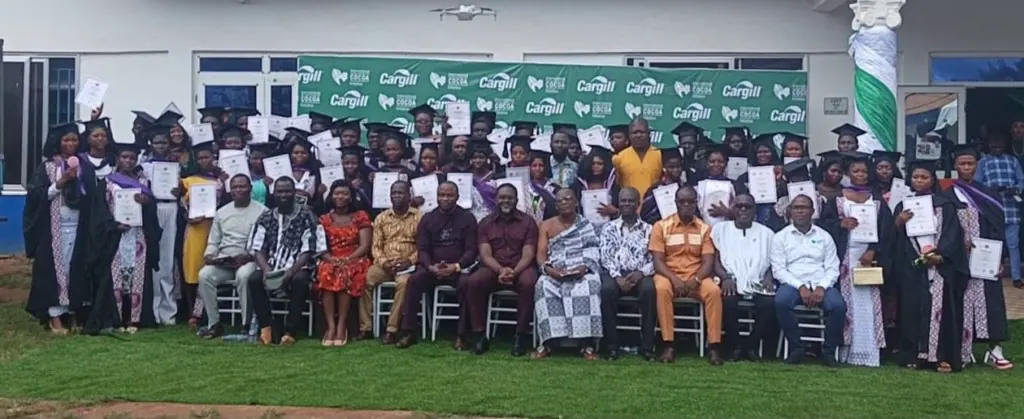
A total of 111 young people, comprising 75 women and 36 men, from cocoa-growing communities in Ghana's Western North region, have graduated with trade skills and start-up tools. The graduation ceremony took place in Debiso, where the young people received certificates and tools for trades such as carpentry, welding, auto mechanics, tailoring, baking, dressmaking, and glass fabrication. This initiative aims to prevent child labour in the cocoa industry by providing young people with practical skills and alternative livelihoods.
The apprenticeship scheme is part of Cargill Ghana's Child Labour Monitoring and Remediation System, which is delivered with support from the International Cocoa Initiative (ICI). The programme has now trained 171 young people in total since its inception. Cargill Ghana's Managing Director, Max Essoh Latte, stated that the initiative is designed to equip young people with practical skills and a route to building their own livelihoods, rather than depending on cocoa farming labour.
The programme's impact is already being felt, with one earlier beneficiary having taken on five apprentices of their own. If other graduates follow suit, the ripple effect could significantly reduce the number of children engaged in cocoa farm work. ICI's Country Director, Mike Arthur, emphasized that creating vocational and economic opportunities for young people reduces their exposure to child labour while strengthening families and cocoa-growing communities.
Child labour remains a persistent problem in Ghana's cocoa belt, where children in farming households are often drawn into hazardous tasks instead of attending school. Programmes like this one aim to provide teenagers and young adults with an alternative income path through a trade, reducing the economic pressure that can push families to rely on child labour.
The start-up tools received by the graduates are meant to enable them to begin earning immediately in their chosen trade, rather than returning to farm work. Cargill's Sustainability Operations Manager, Samuel Apana, stated that the company's commitment goes beyond buying cocoa beans and extends to the long-term sustainability of the sector, including investment in individual skills development and wider community support.
This graduation comes weeks after a report on Ghana's rollout of a new digital system to track child labour cases, known as the GCLMS. The vocational apprenticeship scheme in Debiso operates alongside such monitoring systems, with Cargill's Child Labour Monitoring and Remediation System designed to flag at-risk children and connect them to alternatives like this one.
One of the beneficiaries, Freda Anane, stated that the training had given her more than a trade – it had opened a path towards independence. The sources do not specify a date for the next cohort of apprentices or say how many more communities the programme will expand to. The programme aims to give teenagers and young adults an alternative income path through a trade, reducing the economic pressure that can push families to rely on child labour.
Key points
- The programme has trained 171 young people in total since its inception.
- The initiative aims to prevent child labour in the cocoa industry by providing young people with practical skills and alternative livelihoods.
- The programme's impact is already being felt, with one earlier beneficiary having taken on five apprentices of their own.