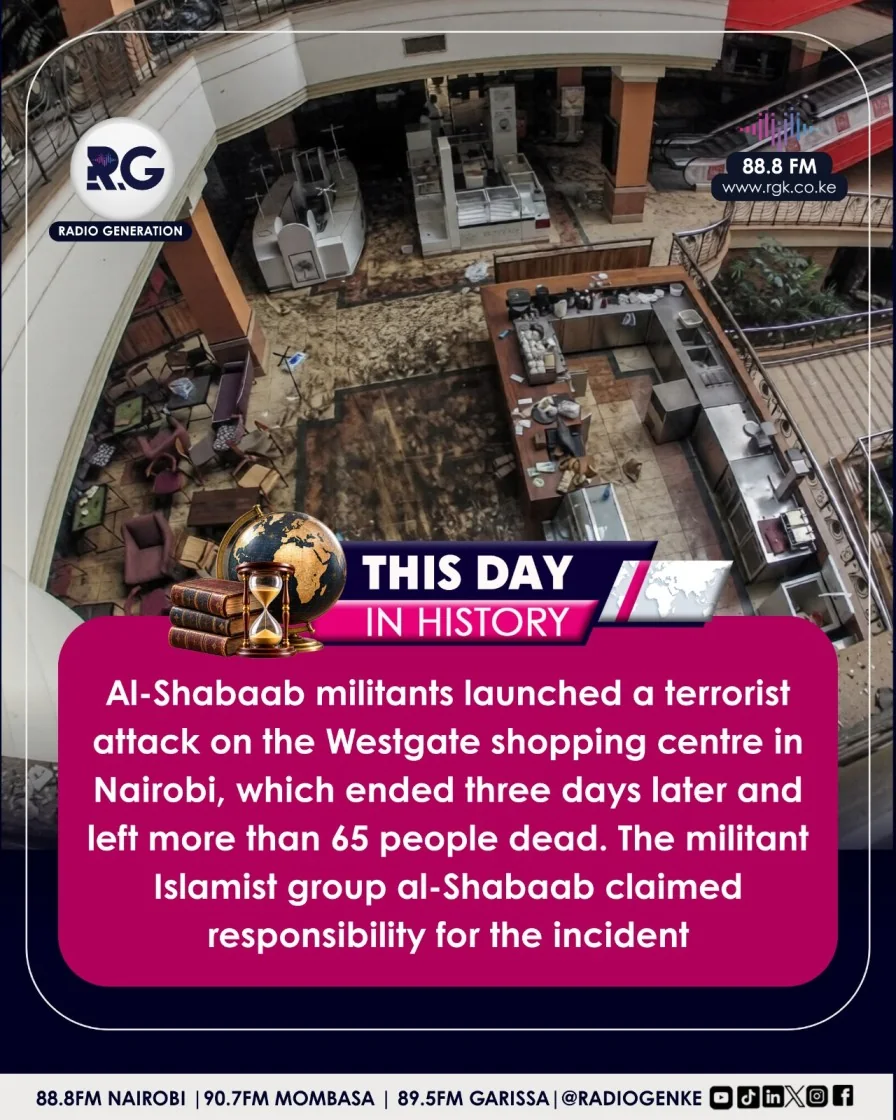
Today marks 11 years since the 2013 Westgate Mall attack in Nairobi, Kenya. On September 21, 2013, four armed Al-Shabaab militants stormed the upscale shopping centre in Nairobi's Westlands area. The attackers arrived at about 12:25 pm in a silver Mitsubishi Lancer and threw grenades near the mall's entrance before opening fire on shoppers. This event resulted in one of the most significant terrorist attacks in Kenyan history.
The gunmen split into groups and moved through the mall, shooting at people inside. At the time of the attack, a children's cooking competition was taking place at the mall. The attackers fired indiscriminately, killing and injuring shoppers, including children. Witnesses reported scenes of panic as people ran for safety or hid inside shops and other parts of the building. The mall was filled with panicked civilians trying to escape.
The gunmen later regrouped inside the Nakumatt supermarket, where they remained as Kenyan security forces launched an operation to secure the building and rescue those trapped inside. Security forces began their main operation at about 4 pm, several hours after the attack started. Police and military personnel surrounded the mall as civilians continued to escape through various exits. The response from security forces was initially hampered by a lack of communication.
During the response, members of the General Service Unit's specialised Recce Company and Kenya Defence Forces soldiers reportedly engaged each other in a friendly-fire incident after entering the mall separately and without adequate communication. The Recce commander, Martin Munene, was killed and two other officers were injured. This incident highlighted the challenges faced by security forces during the operation.
Civilians and security consultants also played a role in rescuing people trapped inside. Several armed and unarmed rescuers entered the mall under fire and helped shoppers, including women and children, reach safety. The siege continued for several days as security forces searched the mall floor by floor. The building was eventually declared secure on September 24, after a prolonged operation.
At least 71 people died in the attack, including 62 civilians, five Kenyan soldiers and the four attackers. About 200 people were injured. The victims included Kenyans as well as foreign nationals from countries including the United Kingdom, India, Canada, France, Australia, China, Ghana, the Netherlands, Peru, South Africa, South Korea and Trinidad and Tobago. Among those killed were prominent individuals such as Kenyan journalist Ruhila Adatia-Sood.
Al-Shabaab claimed responsibility for the attack, saying it was retaliation for Kenya's military intervention in Somalia. Investigators later identified four attackers and linked them to Al-Shabaab. Kenyan authorities also arrested people accused of helping the militants prepare for the attack. In October 2020, a Kenyan court convicted two men of conspiracy to commit a terrorist act in connection with the attack.
Key points
- The 2013 Westgate Mall attack resulted in 71 deaths and 200 injuries.
- The attack was carried out by four Al-Shabaab militants.
- The siege lasted for several days before the building was declared secure on September 24.