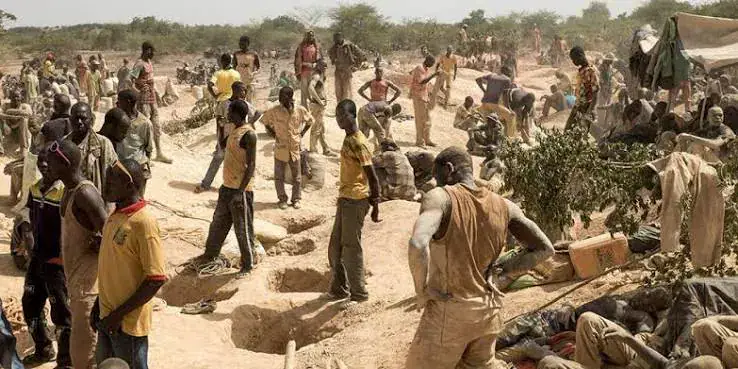
The government of Guinea has expelled 1,557 West African nationals for engaging in illegal gold mining, known as orpaillage clandestin. The individuals, mostly from Burkina Faso and Mali, were arrested in various mining sites across the country and subsequently convicted in Conakry. They were sentenced to prison terms ranging from 18 months to 2 years.
A convoy of 44 vehicles, escorted by security forces and helicopters, transported the expelled individuals to Kourémalé, a border town between Guinea and Mali. The operation was conducted in coordination with the diplomatic representations of the countries concerned. The consulate of Burkina Faso in Conakry accompanied the convoy to the border, where Malian and Burkinabé officials were present to receive their nationals.
The expulsions are part of a broader crackdown on illegal gold mining in Guinea, particularly in the Siguiri region, which is rich in gold resources. The government has accused the activity of causing significant environmental damage and has vowed to put an end to the anarchic exploitation of the country's mineral resources. This has led to the displacement of tens of thousands of West Africans who had been working in the mines.
The situation in Siguiri has turned violent, with at least 10 people killed in clashes between security forces and gold miners earlier this month. The government has blamed the miners for the violence, while the miners claim they are being forced to flee their homes and livelihoods. The expulsions have also sparked concerns from human rights groups, who argue that the government's actions are heavy-handed and inhumane.
The Collective of Forces Vives de Guinée, a coalition of opposition parties and civil society organizations, has denounced the government's actions as "authoritarian" and accused it of using force as a method of governance. The group has called for an end to the violence and for the government to engage in dialogue with the affected communities.
The issue of illegal gold mining is complex, with many West Africans forced to flee their home countries due to poverty and conflict. For these individuals, gold mining provides a means of survival, but it also exposes them to exploitation and danger. The Guinean government's efforts to regulate the industry have been hampered by corruption and lack of resources.
The expulsion of the 1,557 West Africans highlights the challenges faced by Guinea and other West African countries in managing their gold resources and addressing the root causes of poverty and migration. The incident has sparked a renewed debate on the need for sustainable and equitable solutions to the region's economic and environmental challenges.
Key points
- The Guinean government has expelled 1,557 West Africans for engaging in illegal gold mining, as part of a broader crackdown on orpaillage clandestin.